09 March 2010

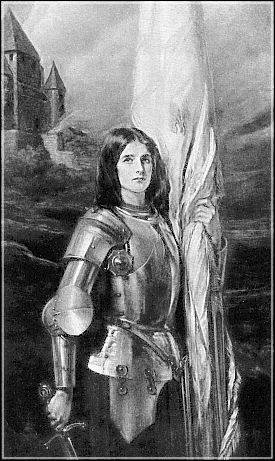
Women's History Profile: Joan of Arc

Joan of Arc was not a crusader for women’s rights or suffrage, those ideals had no standing in her day, but a warrior, fighting for her country by breaking gender roles of the time. 15th century France was a dark and dismal place marked with war, the after effects of the plague and royal feuding. The Hundred Years War was raging, and the English were continually gaining on the offensive. That was until a pheasant girl from a village became a commander in the army, leading France to a series of important victories.

Joan of Arc, born in 1412, had seen the effects of the war from a young age when her village was attacked and burned by opposing forces. At the age of 12, Joan heard her first voices. Throughout her life, Saints came to Joan relying messages from God. Although she would have been happy staying home and taking care of her mother, Joan was instructed by these voices to drive the English out of France and help Charles VII, the rightful heir, take the thrown. Inspired by God, Joan of Arc set off to have an interview at the royal court and help her country when she was 16.

At the court she stated her mission and made a specific military prediction to try and prove divine nature of her quest. When the prediction came true, Joan, a teenage girl with no military training was sent off to Orlèans, the site of an important military siege. She encountered resistance and exclusion from the officers, but her strong religious center raised the moral of the troops, gaining her support and standing. Once a respected officer, Joan of Arc began to make decisions and strategies about the war. She was persistent and defiant in her goal to change the war strategy from defensive into offensive attacks. This new strategy led to a large number of successes for the French army and gained Joan the position of co-commander of the army.

Her successes continued until 1430, when she was captured by the Burgundians. The English government purchased her from the Burgundians shortly after. Joan was a military threat to the English, an enemy of the state and the church. Although she was a religious and pious woman who believed she was instructed by God, she was tried for heresy for, among other things, wearing men’s clothing, a violation of a biblical law., Joan wore men’s clothing for convenience and protection in battle, and protecting herself from sexual assault, which she encountered during her imprisonment, which are actually situations where cross-dressing is accepted by the bible, although this was not recognized by the court.

Throughout the trial, Joan was true to her convictions, unwilling to denounce her role in the military or her clothing attire. She risked her life on the battlefield, and in the courtroom, but in the end it was the law that got her. The court found her guilty, and on May 30th 1431, when she was only 19 years old, Joan of Arc was executed, burned on the stake. This ruling was overturned 24 years later by the Pope, making Joan of Arc a martyr. Five hundred years later, in 1920 Joan of Arc was canonized and became a patron saint of France. A hero in her own time, Joan of Arc is still recognized today for her courage.

Joan of Arc needs to be remembered as a great example of girl power. She embodied the potential all women have to succeed in a male dominated society if she believes in herself. She believed in her cause, her ability and had faith she was doing the right thing. She was independent in a time when a woman’s status and livelihood depended on men, and became a national hero by defying expectations. The strict gender roles of the time meant nothing to this maiden on a mission.

08 March 2010

Women's History Profile: Elizabeth Cady Stanton

Today, we go back a hundred and fifty years to take a look at one of the most famous women’s rights activists, Elizabeth Cady Stanton, Susan B. Anthony’s cohort in the suffrage movement of the 19th century. Although she is best known for her work with the women’s suffrage movement, her passion for women’s rights expanded beyond the scope of many of her peers including Susan B. Anthony. Born in 1815, Stanton was also thrust into the abolition movement until the passage of the 13th amendment in 1865.

What I find the most interesting about Stanton is how she became aware of sexual discrimination in the world and became impassioned to work against it. All of her male siblings had died, leaving her parents with four girls and no male heirs. At a young age, Stanton’s father, a prominent lawyer and politician told her, “Oh my daughter, I wish you were a boy.” This blatant preference of the male sex not only by her father but by society stirred a determination in Elizabeth from a young age to excel in the areas usually reserved to men and to be their equal. Her awareness of society’s prejudices and inequalities grew as her father taught her about the legal barriers between men and women. She also had her own personal experiences of discrimination including being denied admission to the Union college because she was female.

Stanton began her activist lifestyle by standing up for her individual rights within her marriage. Her outrage at the subordinate role of wives beneath their husbands caused her to refrain from vowing to obey her husband in their wedding ceremony. She also refused to be referred to as Mrs. Henry B. Stanton, keeping her maiden name Cady as part of her name. Stanton displayed her convictions and beliefs in her own actions and life, breaking traditions and social standards with no hesitation.

Stanton had been an avid abolitionist for years, but it wasn’t until she met Lucretia Mott at an Anti-Slavery Convention in London she was attending with her husband for their honeymoon, did she become a leader in the women’s rights movement. The two women, official delegates at the conference, were denied the right to participate in the convention by the men because they were female. This discrimination outraged Stanton, and she and Lucretia Mott began planning the first and most famous women’s rights convention.

The Seneca Falls Convention in 1848 was the launching ground for the women’s movemen. Stanton played a major role at the convention, not just as an organizer, but as the writer of the “Declaration of Sentiments.” Written in the style of the Declaration of Independence, it stated that men and women are created equal and demanded voting rights, equal social behavioral standards, and education and was a concrete product of the convention.

An anti-slavery advocate her whole life, Stanton worked tirelessly on abolition during the civil war. Afterwards however, when the 14th and 15th amendments were proposed, Stanton and her associates like Susan B. Anthony felt betrayed by their male abolitionists who did not include giving suffrage to women in the amendments, only African-American males. In fact, they worked against the legislation and tried and failed to pass their own petition that included women.

Yet Stanton was much more than just a suffragist. She was a mother who raised seven children and throughout her life, she advocated for a broad spectrum of women’s rights issues. Legal property and marriage and divorce laws were an important part of her political policy, and she also supported birth control and interracial marriage. Additionally, she spoke out against religion as an institution of discrimination and inequality.

Many of these views and her stance against the 14th and 15th amendments pushed some women away and even caused a schism in the women’s rights organization. But no matter who was offended or disagreed with her beliefs, Elizabeth Cady Stanton stuck to them with dedication and drive. By refusing to compromising her ideals and thinking beyond the limited scope of women’s suffrage, Elizabeth Cady Stanton made her mark on women’s rights and on history, and even though she herself never saw the passage of the 19th amendment in 1920 because of her death in 1902, she was a significant part of why it was passed.

05 March 2010

Women's History Month Profile: Nina Simone

Its funny to me that the only request we have gotten so far for Women’s History Month Profiles is for a musician. I feel like Casey Kasem.

So, this one goes out to our loyal reader Jodi!

Our feature today is, obviously, Nina Simone. I’m going to skip all of the early life information and go right to why she was way more then just a musician.


Nina Simone musically became influential in the early 1960’s. After a few years of teaching piano in Philadelphia, she quickly became popular by performing in Atlantic City bars and night clubs. From there, she was signed by a record label and recorded her breakthrough song “I loves you Porgy” in 1958. The song did extremely well and propelled Simone into musical popularity at the start of the new decade.

Nina Simone wrote songs that defined the times. Many of her recordings evoke singular moments during the civil rights movement and are historically important akin to the popular anti-war music of this era. For example, Simone wrote “Mississippi Goddam” in response to the bombing of a Baptist church in Alabama killed four children and the assassination of Medgar Evers. This and many other songs by Simone were adopted by the civil rights movement and encapsulated the thrust of emotion behind the social movements that were changing the landscape of the US.

Mississippi Goddam (sorry folks, the html link was broken)

In addition to the civil rights movement’s inspiration on her music, the women’s movement was also attracted to Nina Simone and her message heavy lyrics. “Four Women” became a largely popular song for the emerging second wave.

In a 1969 interview Simone stated “There’s no other purpose, so far as I’m concerned, for us except to reflect the times, the situations around us and the things we’re able to say through our art, the things that millions of people can’t say. I think that’s the function of an artist and, of course, those of us who are lucky leave a legacy so that when we’re dead, we also live on. That’s people like Billie Holiday and I hope that I will be that lucky, but meanwhile, the function, so far as I’m concerned, is to reflect the times, whatever that might be."

04 March 2010

Women's History Profile: Judy Chicago


When most of us picture the word ‘feminist’ we probably picture an activist, marching in a crowd of people for suffrage or equal rights, or burning her bra, hair flailing in the air. But feminism expands from beyond the political into the areas of culture, economics and sociology. Judy Chicago, an artist born in 1939 was not out campaigning for women’s rights on the political field with the likes of Susan B. Anthony, but progressing feminism from her studio by her own terms. For her, art was a ‘vehicle for intellectual transformation and social change,’ and she was committed to creating an equal role for women in the art world.

Judy Chicago started Feminist Art in 1970. She coined the term when she started a feminist art program for women at California State University Fresno and then started the CalArts Feminist Art Project. During the next 20 years, Chicago worked on a number of ground breaking pieces, often in collaboration with the women from the Feminist Art Project. These pieces demonstrated, for the first time an openly female point of view and established a centralized focus within women’s art which recognizes an established female imagery.

The Dinner Party, Chicago’s most well known piece and an important event in the women’s movement, was a large triangular table marked with place settings for thirty-nine famous women from history and mythology including the fertility goddess, Hatshepsut, Eleanor of Aquitaine, Sojourner Truth and Virginia Wolfe. The table settings depict the woman’s names and her accomplishments, celebrating women’s achievements in the face of great odds.

Judy Chicago began the feminist art movement because of the marginalization and exclusion she experienced in the art world. To Chicago, the art world denied her "experience and feelings as a female person,” so she and comrades like Miriam Schapiro moved outside of the art world and began their own movement. Since then, many more female artists have been emerging around the world and there is no longer a taboo or self censorship on the pieces women make. Know women know they can be an artist and don’t have to hide their impulses to achieve that. This is probably the most significant way that Judy Chicago and her work has changed the art world, although at this time exhibitions at major institutions rarely feature women.

Over the years, Chicago has faced brutal public and written criticism with poise and strength, never denouncing her work or apologizing for it. Instead she continues to do what she loves, making art that is open about her experiences as a woman and working on humanizing women who for so long have only been the subjects and models from the male perspective, subjectifying them without consideration to their own expression. She has made a place for women in the art world and created a movement for them to express the true being of women without the prejudices and exclusion of the general art world.

This progressive artist is also in touch with the theme of women’s history month, "Writing Women Back into History." She writes in her book, Through the Flower, Because we are denied knowledge of our history, we are deprived of standing upon each others shoulders and building upon each other’s hard earned accomplishments.This was 1975, 35 years later we have not fully embraced women into our history. Judy Chicago is not a political activist, but she has been a key part in creating progress for women in the art world, giving them the freedom to at last be free in their expression.

03 March 2010

Women's History Profile: Amelia Bloomer


The first time I remember learning about Amelia Bloomer was from Shana Corey’s children’s book You forgot your skirt, Amelia Bloomer! This bright and colorful book opens with the line, “Amelia Bloomer was not a proper lady.” This single line resonated with me, a tom boy who was certainly not a proper lady. In fact, I tried to be anything but. As a girl who refused to wear dresses and skirts, the time period before girls were allowed to wear pants terrified me. I cherished my own time period where I had the freedom to put on a pair of overalls or pants instead of being forced to wear heavy pretty dresses drinking tea in the garden. You forgot your skirt, Amelia Bloomer gave insight into the history of pants in American fashion, starting with Amelia Bloomer who revolutionized women’s fashion, popularizing and supporting bloomers in her own newspaper publication.

“Thank you!” was the first thing I thought. This woman, Amelia Bloomer, fought criticism, ridicule and the social culture and gender roles of the time, so that she could wear more comfortable clothing, even if it wasn’t ‘ladylike.’ She played a major role in allowing me to wear jeans and pants today. What she did was not just important for me, but for all women and the break down of gender roles in Western society.

Like me, most people know Amelia Bloomer because of her work in popularizing the fashion style named after her, the bloomers, long baggy pants narrowing to a cuff at the ankles, but she was dedicated to women’s rights throughout her life and worked for woman’s suffrage, the temperance movement, higher education for woman, marriage reform, and other woman’s rights. As a colleague of activists like Susan B. Anthony and Elizabeth Cady Stanton, Amelia Bloomer has an important place as a women’s rights activist in the mid 19th century.

Born in Homer, New York in 1818, Amelia Bloomer was a writer, publisher and editor. Her husband, Dexter Bloomer owned The Seneca Falls Courier, and in the early 1840s, she became a regular contributor to his newspaper, writing about the importance of women’s rights. Her involvement in the women’s movement grew as she continued to write, and in 1849 she attended the Seneca Falls Convention, the most famous women’s rights convention of the time that focused on women’s suffrage.


After the conference, she started her own newspaper, The Lily. The first newspaper in the United States to be owned and operated by a woman, The Lily, focused on women’s issues from suffrage to temperance, education, and fashion. The Lily was very popular, reaching a subscription of over 4,000. Her newspaper was often criticized, however, for giving women the prerogative to speak, when really they should remain silent. Bloomer continued to let her voice be heard by publishing her paper and giving speeches until she died in 1894.

Amelia was able to achieve great things because of her passion and drive, but also because of her husband who supported her and her causes the whole time and was the first person to encourage her to write. She may be remembered as the inventor of the bloomers, but Amelia did so much more than that and deserves a place in our blog as we are "Writing Women Back into History." As a young 7-year-old girl who just wanted to wear my jeans and play baseball, I had a deep appreciation for Amelia Bloomer and her courage to stand up against social gender roles and criticism and promote a revolutionary fashion to liberate women, but now ten years later I understand the larger implications of her work in the women’s movement and dedication to achieving progress.

02 March 2010

Women's History Profile: Hannah Senesh


My first Women’s History Month feature is a woman that I didn’t hear about until way into my college education. I took a class focused on women as diarists/memoirists using this book as a text. Seriously, it’s a great read and I highly recommend it.

Anyway, one of the diarists highlighted is Hannah Senesh. I don’t know what it was about her life or her diary entries that made her stand out from the many other fascinating women we read but here I am, ten years later, anxious to let the blogosphere know my devotion to her story.

Hannah Senesh was born in 1921 in Hungary. In the face of religious oppression, she and her family were Jewish, her mother managed to ensure an excellent education for Hannah (for three times the rate that Protestants were paying).

A side note here: I loved that Hannah’s mother was clearly a strong feminist in her own right. I didn’t know too much about her until recently but I have written in the margins of my copy Hannah’s diary “Moms!” and “I wonder what her mothers story is?” more on this later, though.

Hannah kept a diary from the age of thirteen until her untimely death at 23. In this diary, she recorded her dreams, political ideas, accounts of the events unfolding around her, and of course, her convictions about her responsibilities as a Jew during World War II. Right at the outbreak of WWII, Hannah left Hungary and her family to emigrate to Palestine. In her diaries we learn that she was dedicated to her personal development of an authentic and independent identity and her belief that love was always waiting to be expressed through service to others.

This theme, service to others, is the thread that continued throughout her life. She wrote, “One needs something to believe in, something for which one can have whole-hearted enthusiasm. One needs to feel that one’s life has meaning, that one is needed in this world”. The most dramatic manifestation of this ideal, and the reason she had become monumental to women’s history as well as Jewish history, was her decision to join up with a special group of Palestinian soldiers trained by the British to help Jews escape from occupied countries. Her unit parachuted into Yugoslavia in March of 1944. By that time, Hungary was already occupied by Nazis and Hannah was captured and imprisoned in Budapest.

In prison she maintained her service despite the unimaginable conditions by teaching the other prisoners Hebrew and made the children dolls out of whatever she could find. She refused to reveal the secrets entrusted to her even when the Nazis threatened to torture her mother who was housed at the same prison. Hannah herself was severely beaten and tortured. She was executed on November 7th, 1944.

Hannah Senesh is a personal hero of mine for many reasons. Her dedication to service is something that I reflect on often. In a less evil time, she may have lived an ordinary life as a teacher or community organizer. This was not the case, and she took her passion for service and stood up to the wrongs she saw. In a letter to her brother two days before she left on her mission she wrote “There are events without which one’s life becomes unimportant, a worthless toy; and there are times when one is commanded to do something, even at the price of one’s life”

Strangely enough (and luckily), when I was doing a little background googling on Hannah Senesh this morning I came across a documentary that has been made about her life called “Blessed is the Match” AND it is playing in Pittsburgh on March 9,10,12 and 18. Visit www.vjfpittsburgh.org to get tickets. According the the director, the film is a tribute the mother and daughter relationship of Catherine and Hannah Senesh through the telling of their story. Field trip, anyone?

01 March 2010

Women's History Profile: Margaret Sanger


I am sure everyone is exhaling a sigh of relief today in Pittsburgh. It's March 1st which means February's dreaded reign is officially over. Here's hoping the first week of this month is more lamb like than lion. What you may not know is that today is also the first day of Women's History Month. This year's theme is "Writing Women Back into History." When the National Women's History Project began its mission in 1980, less than 3% of the content of teacher training textbooks mentioned the contributions of women. It is all of our responsibilities to recognize the impact of great women in history. PPWP will be blogging all month on the women we've been influenced by.

Today, I thought it was only fitting to do a profile on Margaret Sanger, founder of Planned Parenthood Federation of America and pioneer of the birth control movement.

Margaret Sanger was the sixth of eleven children born to Anne Purcell Higgins and Michael Hennessy Higgins, a devout Catholic family in New York. As a child, Margaret was profoundly influenced by her mother's seemingly constant state of pregnancy. She often played caretaker to her younger siblings. After her mother's death from tuberculosis and cervical cancer in 1896, Margaret enrolled in a nursing program paid for by her sisters' wages.

When Sanger moved to New York City after a tragic fire destroyed her and her husband's home, things started to get interesting. She went to work in the East Side slums of Manhattan. At the same time she was writing a column called "What Every Girl Should Know" for the New York Call and distributing a highly controversial pamphlet called "Family Limitation." It was her belief that women would never be equal to men as long as they had no self-determination over their reproduction and that women should be allowed to enjoy the sexual freedom experienced by men. Margaret risked imprisonment by writing about birth control during the age of the Comstock Laws. At that time, it was illegal to disseminate contraceptive information and devices on the basis that they were obscene.

In 1916, Margaret opened a family planning clinic in Brooklyn. It was raided by the police soon after and Margaret served a prison sentence for violating the Comstock laws. In 1921, she started the American Birth Control League, the precursor to today's Planned Parenthood Federation of America. Sanger was able to open her first legal family planning clinic not long after when she found a loophole in the Comstock laws that allowed for physicians to disseminate birth control information when prescribed for medical reasons. The clinic was staffed exclusively with female physicians and social workers. Margaret Sanger would later resign as President of the American Birth Control League but served as president of the International Planned Parenthood Federation from 1952 to 1959.

Margaret Sanger's legacy has often been tainted by rumors of her belief in the practice of eugenics, a philosophy that aims to improve human genetic traits through social intervention. In fact, when googling "Margaret Sanger," the fourth entry is a link to a website called blackgenocide.org. However, it is important to recognize that the "evidence" that depicts her as a eugenicist has been compiled by a anti-choice community that would end the practice of birth control and abortion for all women in the United States. Their motives are questionable at best and the quotes they have used to present the case for Margaret Sanger as a eugenicist, have largely been taken out of context or mis-attributed to her.

Regardless of the controversy, Margaret Sanger is a true hero of the reproductive rights movement. She fought against censorship her entire career and sacrificed her freedom and safety to provide contraceptive information and services to all women. I am happy to tell you that Margaret lived to see the development of the birth control pill and the end of the Comstock laws. She died just a few short months after the Griswold v. Connecticut decision that legalized birth control for married couples in the U.S.

Want more info? Super activist Gloria Feldt tells all about the courageous Margaret Sanger in this speech, Convictions to Action: Margaret Sanger's Legacy and Leadership Lessons.

Check it out and stay tuned for more women's history profiles this month courtesy of PPWP!